Investigation
How a people loses its land, in seven steps
By the OPAF editorial team2 min read
From one country to the next, the stories look alike. That is no accident: the same machinery, almost always legal, leads to dispossession.
It starts with an omission written into law. African states, heirs to colonial codes, do not recognise land rights based on use: hunting, gathering or grazing does not give a title. That non-recognition makes every other violation possible.
1. The law
In Cameroon, hunting and gathering do not establish ownership, and so-called “vacant” land belongs to the state. In Botswana, Tanzania and Kenya, the colonial model of “Crown land” was kept as it was. The Mbororo hold grazing permits, not titles.
2. Fortress conservation
Lobéké, Campo Ma’an, Kahuzi-Biega, Bwindi, Mau, Ngorongoro, Loliondo, Etosha: everywhere, protected areas were created by evicting the very people who had preserved them. Abuses by rangers funded by major donors are documented from eastern Cameroon to South Kivu.
3. Extraction
Logging concessions, agribusiness, diamonds, uranium at Arlit, oil in Ogoniland, gold panning, large dams such as Lom Pangar, Gibe III or Baynes. The free, prior and informed consent of communities is almost always missing.
4. New carbon markets
REDD+ contracts have been signed over millions of hectares, sometimes used to justify evictions. In Tanzania, at Yaeda-Eyasi, credits bought for €4.75 were resold for more than €31.
98% of Baka children have no birth certificate. No papers means no school, no vote, no recourse.
5. Invisibility
Without a birth certificate or an ID card, you do not exist for the administration. Nubians in Kenya face “vetting” to get their cards; some Toubou have been stripped of their nationality in Libya.
6. Discrimination and violence
Servitude imposed on the Baka and Aka by neighbours, contempt for those without cattle, prejudice equating the Fulani with jihadists or the Tuareg with rebels: these stereotypes have led to massacres, from Ogossagou to Solenzo. In Rwanda, around 10,000 Twa were killed during the 1994 genocide.
7. Climate and forced settlement
Droughts from 2020 to 2023 in East Africa, collapsing fisheries in the Niger Delta, closed transhumance corridors, 4.2% of Cameroon’s forests lost in five years. Forced settlement completes the process, bringing disease and the loss of languages: N|uu has a single speaker left.
The African paradox
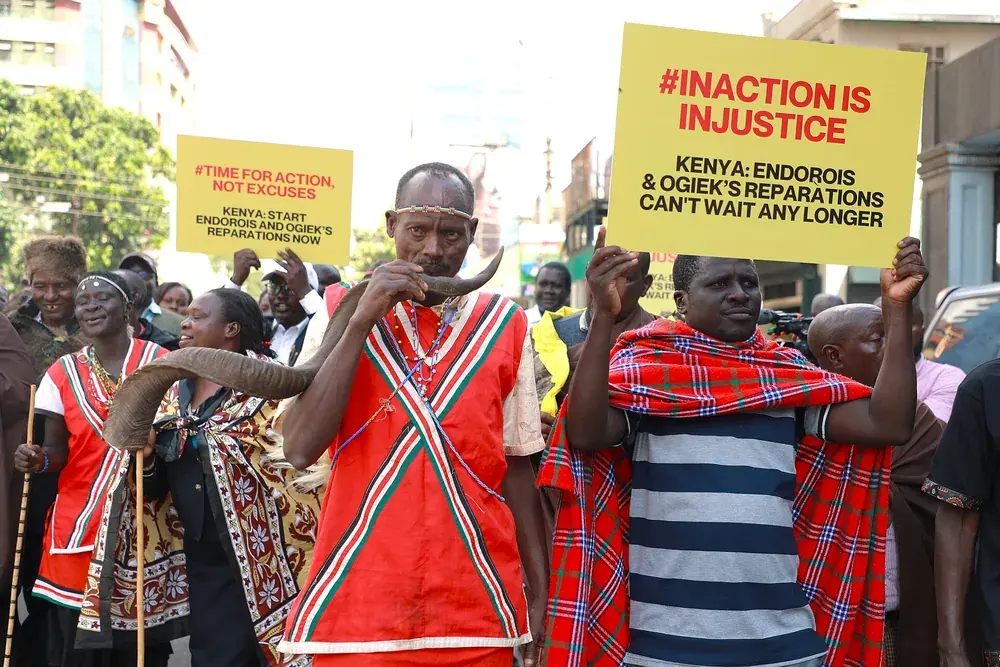
Africa has the most advanced Indigenous case law in the world. It is also the place where it is least applied: on 4 December 2025, the African Court found that Kenya had implemented “no part” of the judgments in favour of the Ogiek.
Naming these seven steps is already a way to start fighting them. It is also why OPAF lets communities document their places with dates and coordinates: evidence is stronger than memory.